
When did you last say “I was wrong” at work?
What is psychological safety and why it is the number one indicator of high performing teams across organizations.
Psychological safety is the shared belief that you can speak up — ask a question, raise a concern, challenge an idea, or admit a mistake — without fear of punishment or humiliation. The term was defined by Harvard professor Amy Edmondson in a landmark 1999 paper. It is not about being nice, lowering standards, or avoiding disagreement. It is the reason the best teams in Google's Project Aristotle study outperformed teams with more talented individuals, and the reason the best hospital nursing teams in Edmondson's research reported more errors than the worst ones. This is what it is, what it is not, what erodes it, and what a manager can actually do about it.
In her 1999 paper, Amy Edmondson published research on hospital nursing teams. Their expectation was that the best, top performing teams would be the ones that made less mistakes. What they found out instead is that the best performing teams were the one that reported more mistakes than the worst ones. That makes no sense, right? Better teams, more errors?
The truth is that the best teams weren’t making more mistakes: they were the only ones that felt safe enough to talk about them. The weaker teams looked spotless on the record because their errors stayed hidden, unexamined, and free to happen again.
Between 2012 and 2015, Google ran Project Aristotle, a study of what makes teams effective: they expected to find that the best teams were built from the best individuals. Instead, across 180 teams, the strongest predictor of performance was not talent, tenure, or team size. Nor the IQ of the team members. It was the ability to share mistakes openly with the rest of the team. How safe people felt mattered more than who was on the team.
This ability to talk openly about mistakes has a name: psychological safety.
What Psychological Safety actually is
Psychological safety is the shared belief that you can speak up (ask a question, raise a concern, challenge an idea, or admit a mistake) without fear of punishment or humiliation. It’s the idea that when admitting a mistake, team members are met with a fix, not a reprimand or humiliation.
The term was defined by Harvard professor Amy Edmondson in a landmark 1999 paper, and it has since become one of the most studied ideas in organizational science.
Returning to that hospital study we mentioned at the beginning, Edmondson originally set out to test a tidy hypothesis: better teams make fewer errors. The data said the opposite: the highest-functioning units recorded the most. The puzzle dissolved once she looked closer. The strong teams had built an environment where a nurse could say “I think I gave the wrong dose” and be met with a fix, not a reprimand. On the weak teams, that sentence was career-threatening, so it never got said.
The mistakes still happened. They just went underground.
This is the mechanism behind every high-performing team worth the name. Safety does not lower the error rate on paper, it raises the reported error rate, which is the only kind you can actually learn from. A team that hides its mistakes is not safer. It is blind.
A team's silence is not the absence of problems. It’s the absence of information.
That single insight reframes what good leadership looks like. The goal was never a team that never errs. It is a team safe enough to surface errors early, learn from them quickly, and get better because of them.
What it is not
Few ideas are as widely misunderstood. Psychological safety is not:
• Being nice. It is about candor, not comfort. Hard truths still get said, directly, even when uncomfortable.
• Lowering the bar. Standards stay high. Safety is how a team reaches them honestly.
• Endless agreement. Healthy challenge and disagreement are the entire point. The goal is to manage potential conflict, not to avoid it.
• A free pass. Accountability remains. What disappears is the penalty for honesty. The goal is not to punish, but to avoid the same mistakes to happen again.
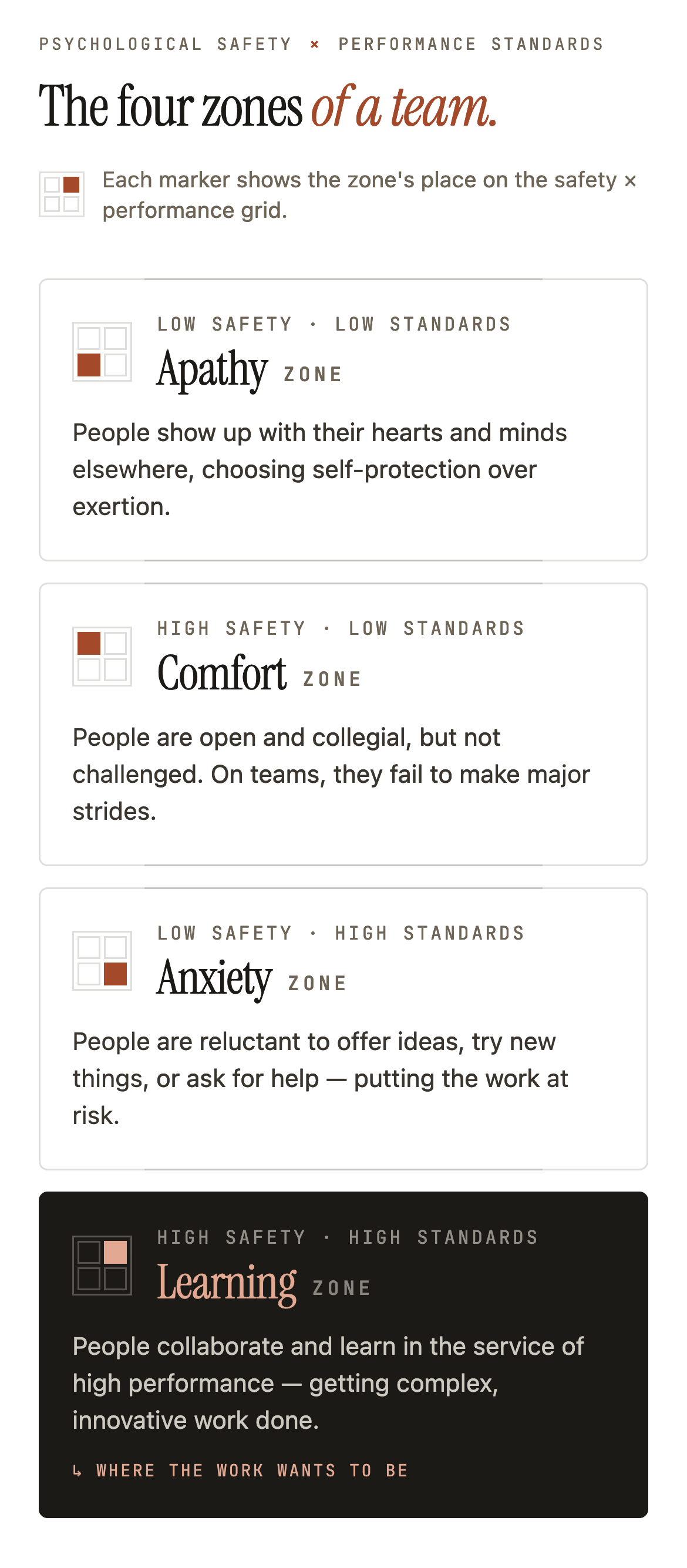
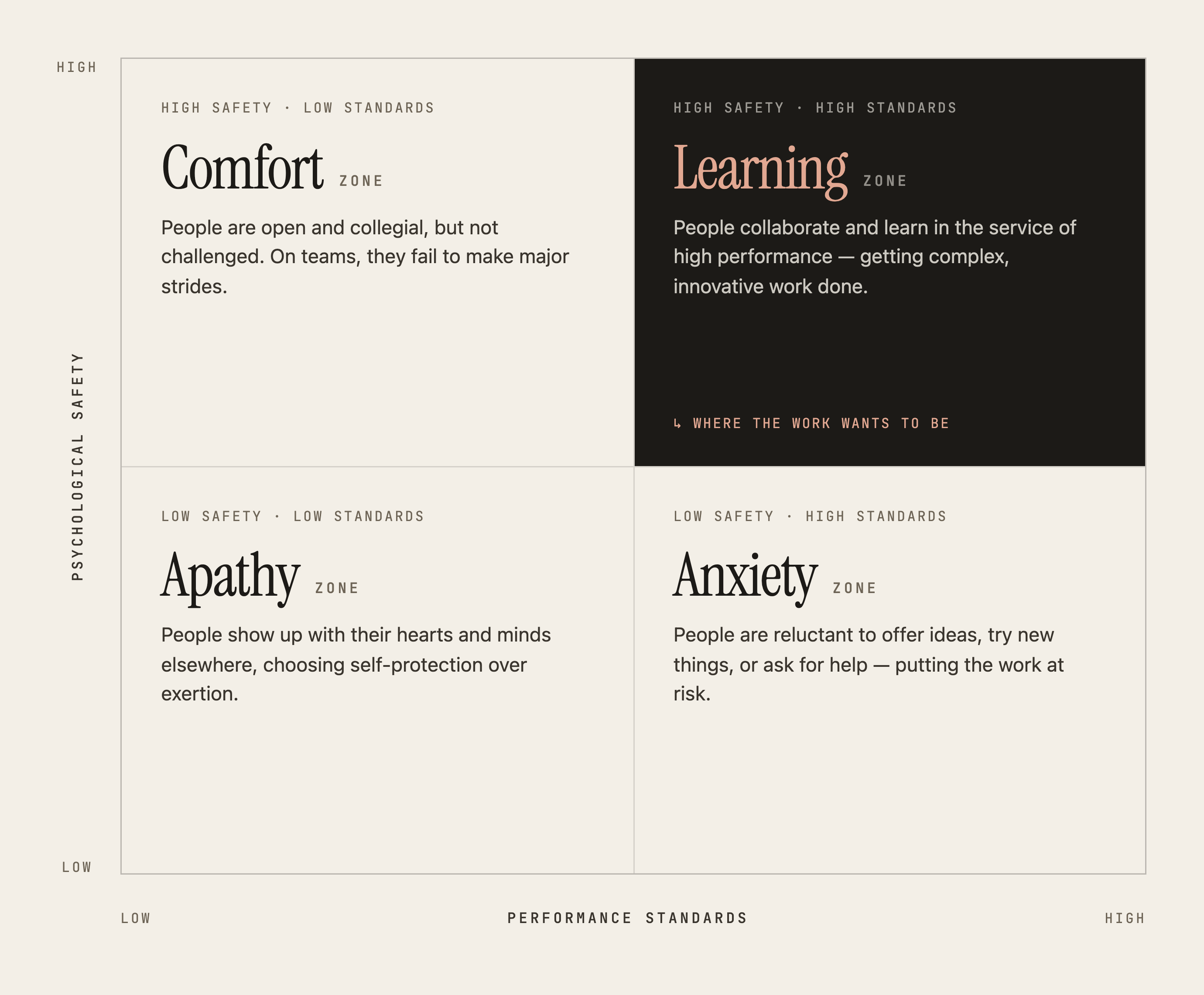
High Standards + High Safety = The Learning Zone
Standards without safety produce anxiety; people hide problems to survive.
Safety without standards produces complacency.
Put the two together and you get a team that aims high and tells the truth about how it is going.
That is what Dr. Edmondson calls the learning zone: high standards and high safety, where people can collaborate and learn in service of high performance. It’s where innovative work actually gets done.
You can’t learn from a mistake you’re hiding.
The most visible threat: Micromanagement
If safety is built on trust, micromanagement is its most common solvent. The numbers are stark. 79% reported having been micromanaged; 71% said it interfered with their job performance; and 85% said their morale was damaged. Most telling for anyone who cares about retention: 69% said they considered changing jobs because of it, and 36% actually did.
Micromanagement sends a precise signal: I do not trust your judgment.
People who hear that signal often enough stop bringing judgment to work at all. They wait to be told. They stop flagging the small problems that, left unspoken, become big ones.
The crucial nuance: the answer to micromanagement is not absence. Disappearing entirely, with no direction and no support is its own failure mode. People feel adrift, not free. The target sits between the two extremes: clear outcomes and genuine support, without dictating every step. That middle ground has a name too. It is coaching.
It’s not just micromanagement
Micromanagement is the easy villain because it is so visible. But safety more often dies a quieter death — on teams led by warm, hands-off managers who would never dream of hovering. The erosion comes from a dozen smaller things, and a leader who only watches for micromanagement will miss most of them. The causes cluster into four sources.
From the leader
The most powerful lever, for better or worse. Safety rarely survives a leader who punishes the messenger, who greets bad news, hard questions, or admitted mistakes with visible irritation. Just as corrosive is the say-do gap: inviting candor in words, then bristling at it in practice. People read the behavior, not the invitation.
From the team
Even with a good leader, safety erodes when a few dominant voices crowd out the rest, when disagreement gets settled by volume, or when criticism happens in public. The quiet members learn to stay quiet. Concerns raised once and then ignored teach everyone that raising them is pointless.
From the system
Some threats are structural and outlast any single manager: looming layoffs, steep hierarchy, forced stack-ranking that pits colleagues against each other. These tell people that honesty is a luxury they cannot afford.
From within
Finally, the fears we carry into the room. Edmondson names four interpersonal risks people manage by staying silent: looking ignorant (so they don’t ask), incompetent (so they don’t admit mistakes), intrusive (so they don’t offer ideas), or negative (so they don’t challenge). Each silence feels individually rational and is collectively expensive.
Noticing who didn't speak is more advanced than avoiding micromanagement. It's the difference between not being the problem and actively building the solution.
What managers can do to build a safe environment
Building safety is not a workshop or a poster. It is a hundred small choices that tell your team the truth is welcome here. A few that matter most:
Model fallibility
Say “I was wrong” and “I don’t know” out loud. Permission flows downhill from whoever holds the most power in the room.
Reward the messenger
When someone brings you bad news early, thank them visibly, especially if it is inconvenient. You are pricing honesty every time you react.
Ask better questions
Replace “Any questions?” (which gets silence) with “What are we missing?” or “What would have to be true for this to fail?”.
Don’t tell people what to do
Instead of “Do it this way” ask “What would you do in this situation?”. This creates a sense of ownership of the solution.
Read the silence
Notice who has not spoken, and make room for them. Silence is data, not consent.
Separate the person from the problem
Attack the issue hard, never the human. The two must be visibly different things on your team.
None of this lowers the bar. It is how a serious team reaches a high bar without lying to itself along the way.
When safety breaks down, delivery breaks down
Building psychological safety isn't a culture initiative. It's a delivery problem. When people don't speak up, estimates are wrong, blockers stay hidden, and the first sign of trouble is a blown deadline. By the time the issue surfaces in a status report, it's been sitting in someone's head for weeks.
I've worked across enough teams to recognise the pattern quickly. The standups that feel too smooth. The retrospectives where nothing critical gets said. The senior stakeholder who's surprised by something three people already knew. These aren't communication failures. They're safety failures, and they show up directly in the work.
Part of what I do is help teams change that. Not just through workshops or frameworks, but by working alongside them, modelling the behaviours, reshaping the conversations, and building the kind of environment where a problem flagged on Monday doesn't become a crisis by Friday. It's slower than a training session and more durable than one.
If your team is stuck in the silence, I can help you find out why and build something better.
FAQs
-
A: Edmondson's seven-item survey is the established instrument, but on a live program the faster signal is behavioural: count how often bad news reaches you early rather than late, and notice who has not spoken in the last three meetings.
-
A: No. Trust is between two people. Psychological safety is a property of the group — a shared belief about what happens when someone takes an interpersonal risk in front of everyone.
-
A: That combination is the point. Edmondson calls high standards plus high safety the "learning zone". Standards without safety produces anxiety; safety without standards produces complacency.
-
A: Say "I was wrong" and "I don't know" out loud, in front of the team. Permission flows downhill from whoever holds the most power in the room.
START A CONVERSATIONTell me what's stuck.
I'll tell you if I can help.
A few lines is enough. Tell me what you're working on, when it needs to land, and I'll come back with a view on whether I'm the right fit.
+45 52 15 96 75
Sources & further reading
Figures are drawn from the sources below. The micromanagement statistics come from a single survey (Trinity Solutions, reported in Chambers, 2004) and are best read as illustrative of a widely reported pattern rather than population-level estimates.1. Edmondson, A. C. (1996). “Learning from Mistakes Is Easier Said Than Done.” Journal of Applied Behavioral Science. The nursing-team study behind the “better teams report more errors” finding; recounted in Edmondson’s The Fearless Organization (2018) and Right Kind of Wrong (2023).2. Edmondson, A. C. (1999). “Psychological Safety and Learning Behavior in Work Teams.” Administrative Science Quarterly, 44(2), 350–383. The paper that defined the term; studied 51 teams in a manufacturing company. 3. Google re:Work. “Guide: Understand team effectiveness” (Project Aristotle). Identifies psychological safety as the top factor across 180 teams. 4. Edmondson, A. C. (2008). “The Competitive Imperative of Learning.” Harvard Business Review. Source of the learning-zone matrix crossing psychological safety with accountability.5. Chambers, H. E. (2004). My Way or the Highway: The Micromanagement Survival Guide. Berrett-Koehler. Reports the Trinity Solutions survey: 79% micromanaged, 71% performance interference, 85% morale damage, 69% considered leaving, 36% changed jobs.6. Edmondson, A. C. (2018). The Fearless Organization. Wiley. Source of the four interpersonal risks — appearing ignorant, incompetent, intrusive, or negative.